

A Visual Landscaping Proposal App That Closes Deals — CurbReady AI
The Problem
The average landscaping estimate looks like a receipt from a hardware store. Line items, material costs and labor hours (if you’re lucky), and a total at the bottom that means almost nothing to a homeowner who has never contracted a landscaper before. There are no pictures of what the yard will look like once finished. There is no sense of what happens as the project progresses. There is just a number requiring the user to take a leap of faith.
That leap of faith is where deals often die.
Landscapers tend to lose jobs because their proposals give homeowners every reason to hesitate, not because their work is bad. When the proposal is confusing, the easiest decision is to get another quote. And another. And another. By the time a homeowner circles back, they feel lost.
What if the proposal itself could close the deal?
That question became CurbReady.ai, an AI-powered mobile platform that transforms a landscaping consultation into a visual experience. A landscaper takes photos of the yard, enters notes from the walkthrough conversation with the homeowner, and CurbReady generates AI renders of the finished property, complete with seasonal views, growth projections, and a week-by-week plan that ties every phase of work directly to a payment on the invoice. The homeowner stops looking at numbers and starts looking at their future yard.
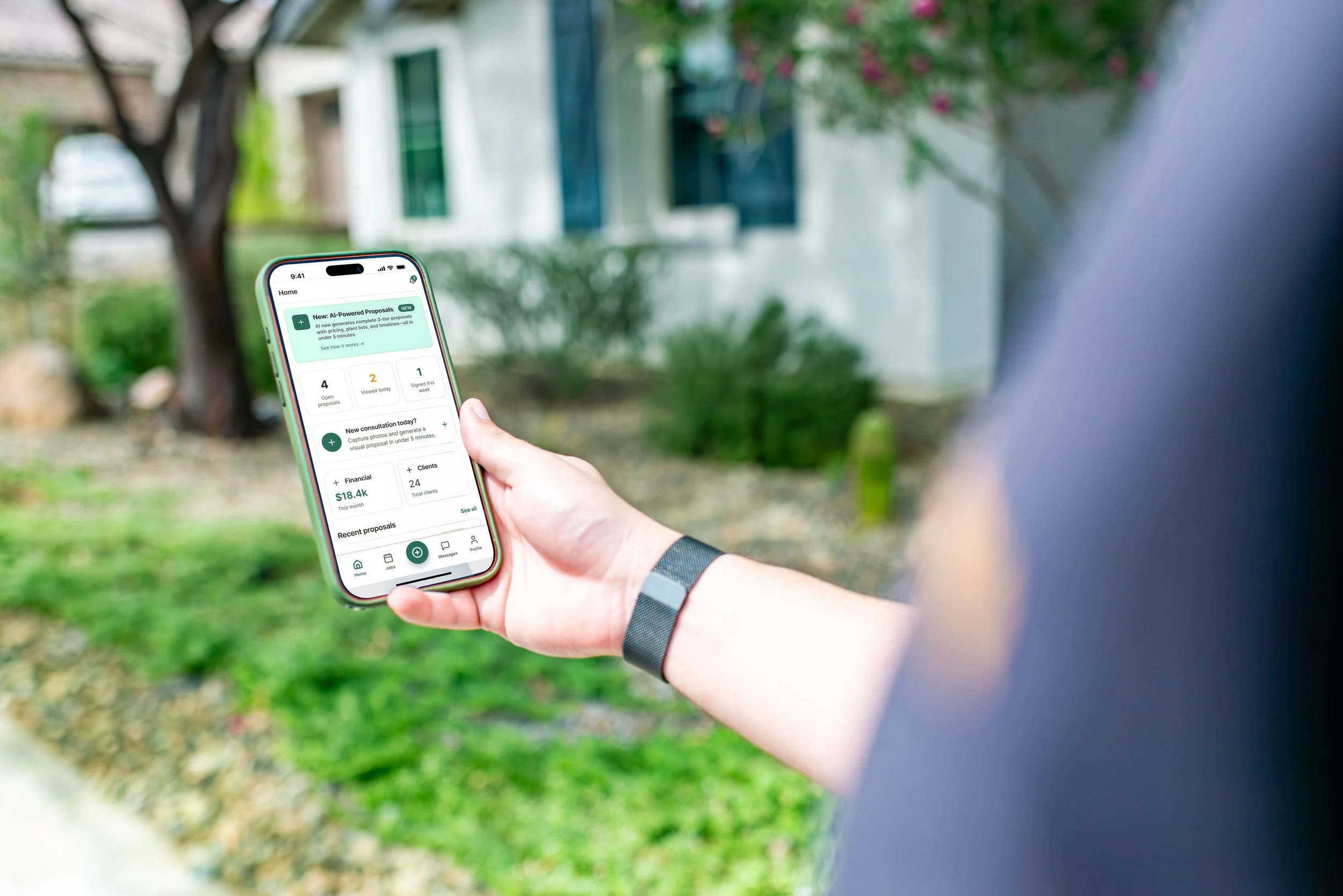
CurbReady mobile app dashboard featuring a financial summary, client list, and the option to generate a new proposal.
But a powerful back end only matters if someone can actually use it. A solo landscaper running a business from a phone, mid-job, in the field, does not have time to learn new software. Our job was to design an experience that felt as natural as taking a photo.
Three Problems Worth Solving
CurbReady.ai is built around three friction points that often kill landscaping deals every day.
The first is visualization. Homeowners struggle to picture what a finished yard will look like from a text description or a line-item estimate. CurbReady addresses this by generating AI renders of the actual property, not a stock photo of a generic yard, but that specific house with those specific dimensions and that specific light. Seasonal views and growth stage projections extend the picture further, showing what the yard will look like at install, six months later, and the following spring. Homeowners stop buying a service and start buying an outcome.
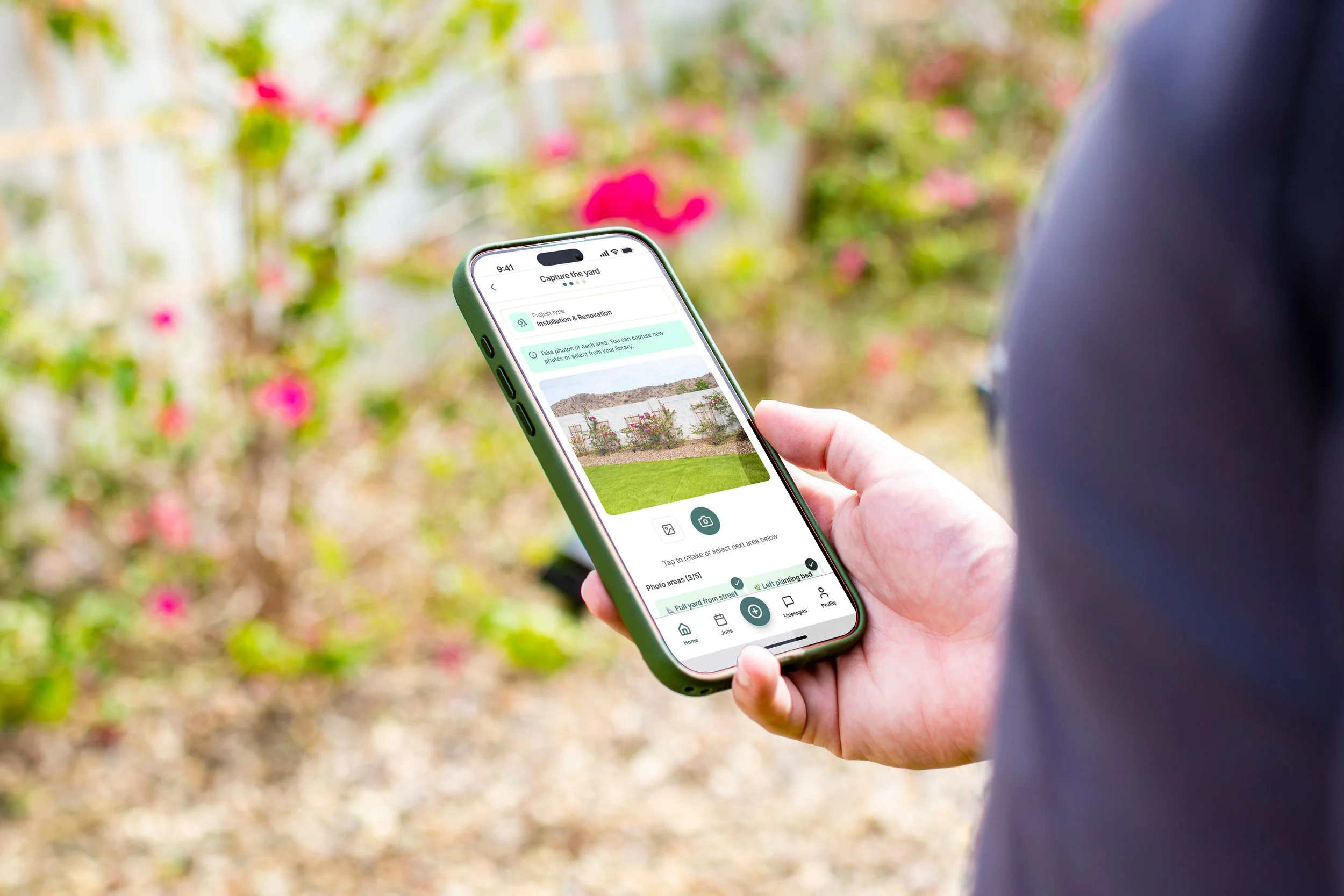
Landscapers can take photos and add notes as they conduct a site walkthrough with their clients to generate context-specific imagery within their proposals.
The second is invoice clarity. A traditional landscaping invoice is a wall of information with no visual connective tissue between the work and the cost. CurbReady builds a step-by-step project schedule where each phase is directly linked to a payment, so a homeowner can see exactly what they are paying for at every stage. The invoice becomes a roadmap, not a bill.
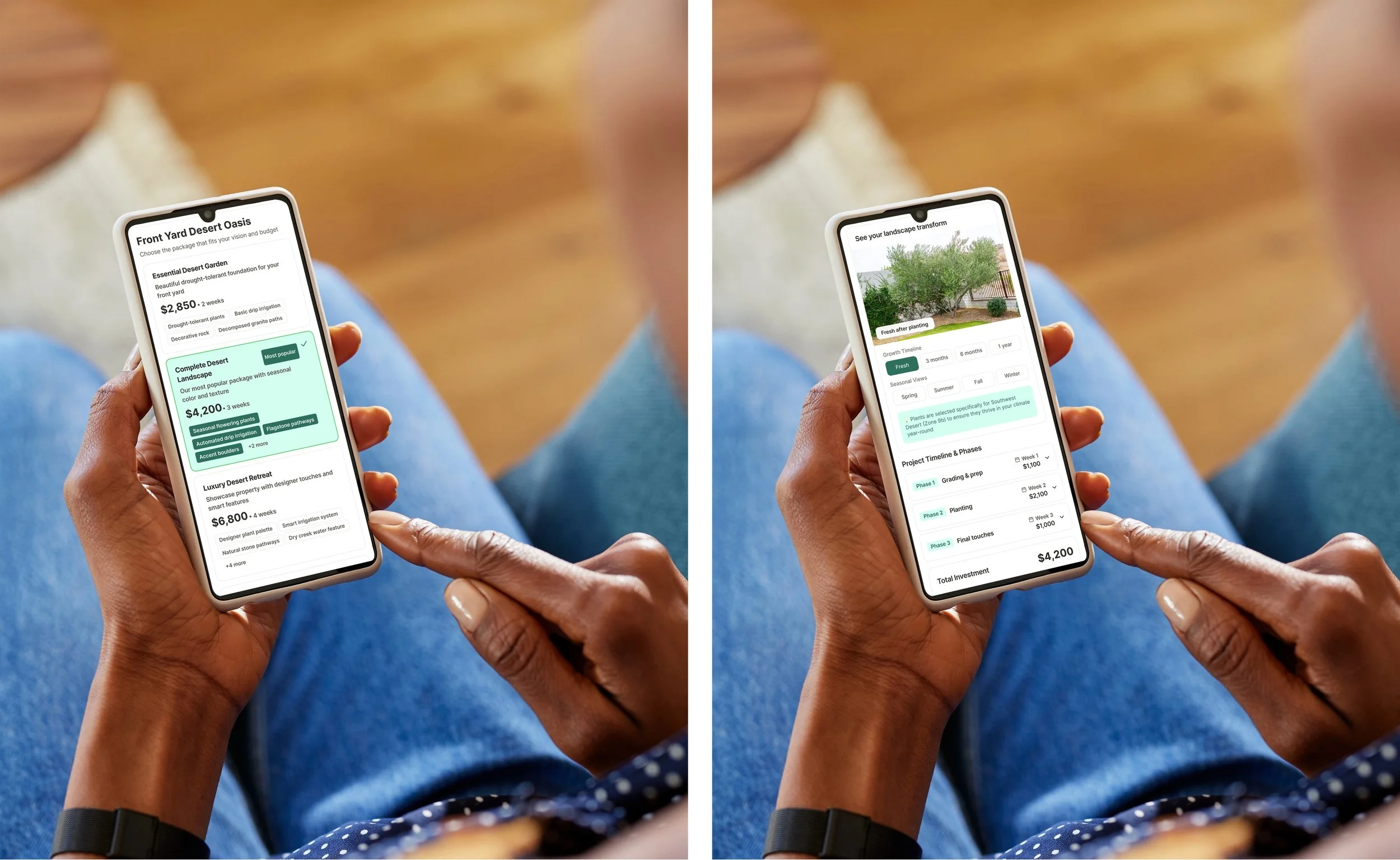
A landscaping client reviewing their customized AI proposal from a link sent via email or SMS directly from the landscapers in-app proposal generator.
The third is trust. Landscaping is a high-consideration purchase. Homeowners are handing over control of a significant piece of their property to someone they may have met once. A branded, professional visual proposal signals competence before a single shovel goes in the ground. It tells the homeowner that this landscaper is organized, accountable, and worth the investment.
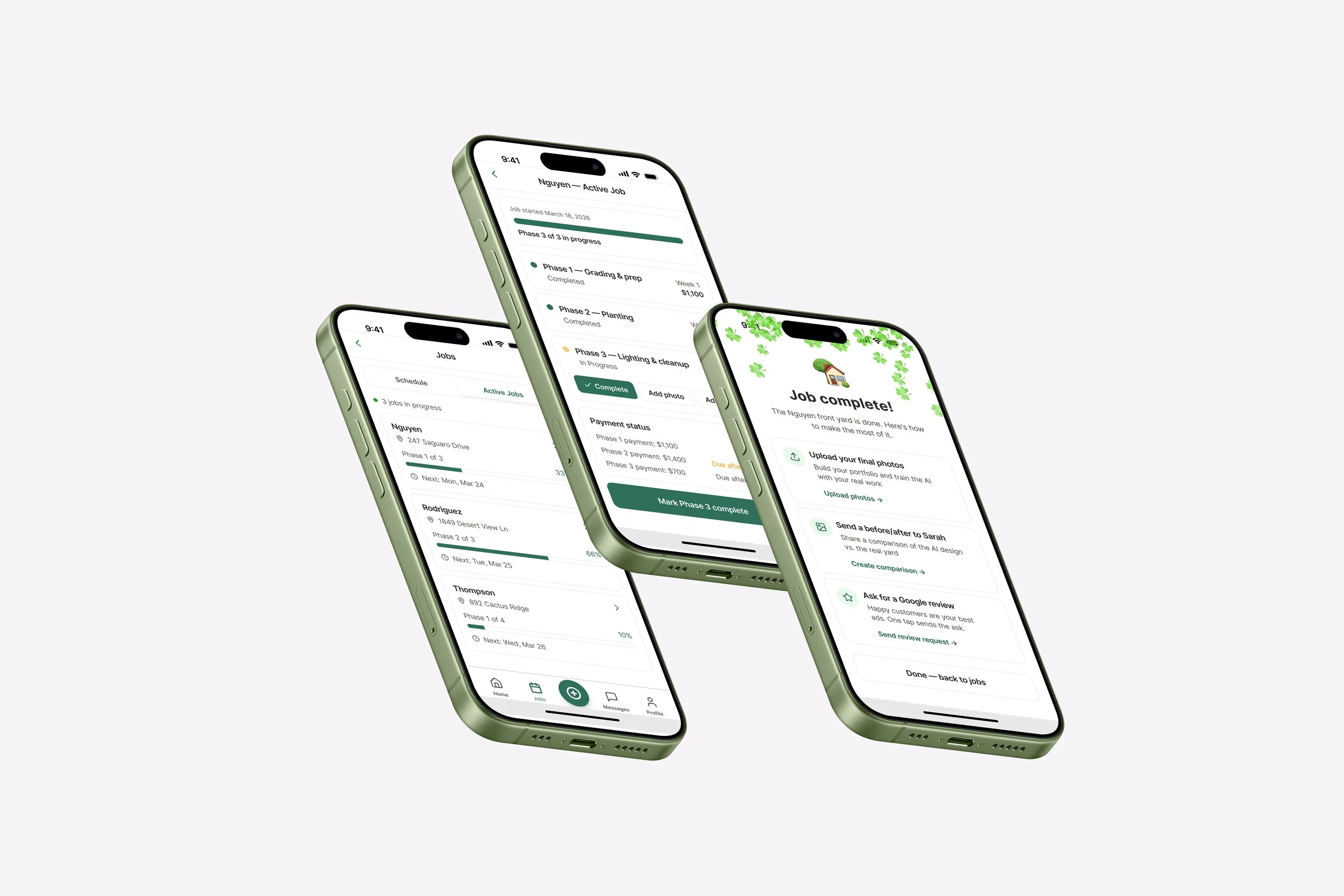
Within the CurbReady app, landscapers can keep track of project phases, add photos upon completion and keep track of project profit and loss. Upon completion of each phase, photos from completion and project updates are sent to the client to help maintain transparency and trust.
Understanding the User
We designed CurbReady.ai primarily for solo landscapers running a business in a mid-sized market. These landscapers like to do everything themselves, from bidding jobs to running equipment to following up with customers. They are on their feet twelve hours a day, their phones are in their pocket at all times, and they evaluate every new tool with a simple question: Does this help me close jobs, or does it slow me down?
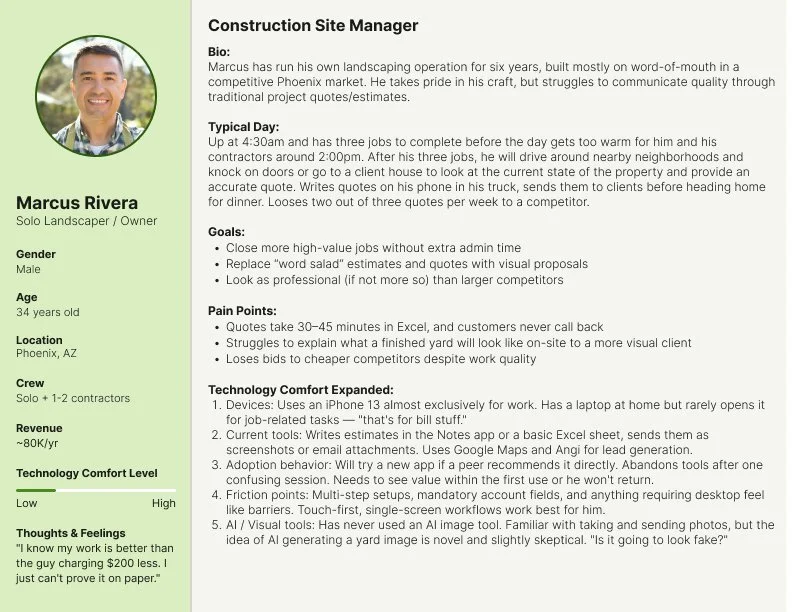
User persona for Marcus Rivera, an embodiment of the typical landscaper in the U.S.
This is what the majority of landscaping professionals in the United States look like. They are not managing a team of estimators or have a dedicated sales process. They win jobs through referrals, reputation, and the impression they make in a thirty-minute yard walk. CurbReady had to fit into that thirty-minute window, or it would never get used at all.
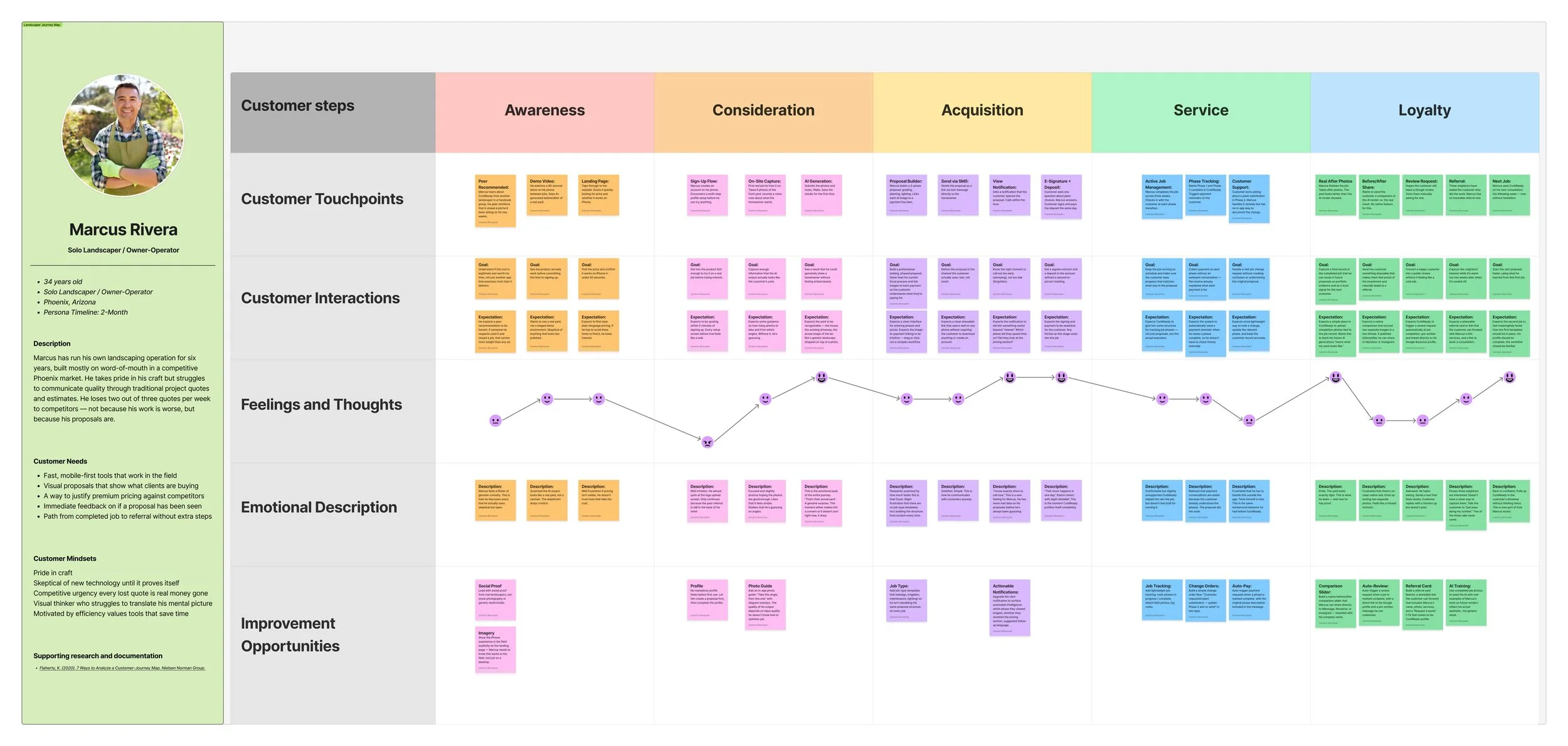
User Journey Map for Marcus Rivera.
Alongside Marcus, we developed a persona for a typical homeowner receiving the proposal who has a busy schedule, needs visuals to help them understand and visualize exactly what they are getting with each estimate, and wants to see options so they can decide what fits within their budget.
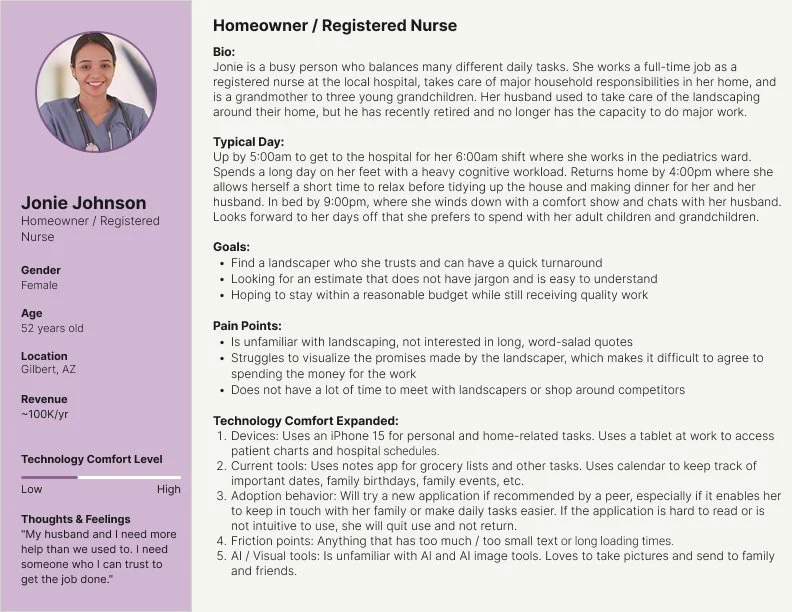
User Persona for Jonie Johnson, an embodiment of the typical landscaping client.
What We Designed
The core workflow follows the natural shape of a landscaping consultation. A landscaper opens the app, photographs the yard, enters notes from the conversation with the homeowner, and CurbReady handles the rest. AI renders are generated directly on top of the real property. The project schedule builds from the scope of work. The proposal packages everything into a branded document that can be sent before the landscaper even leaves the driveway.
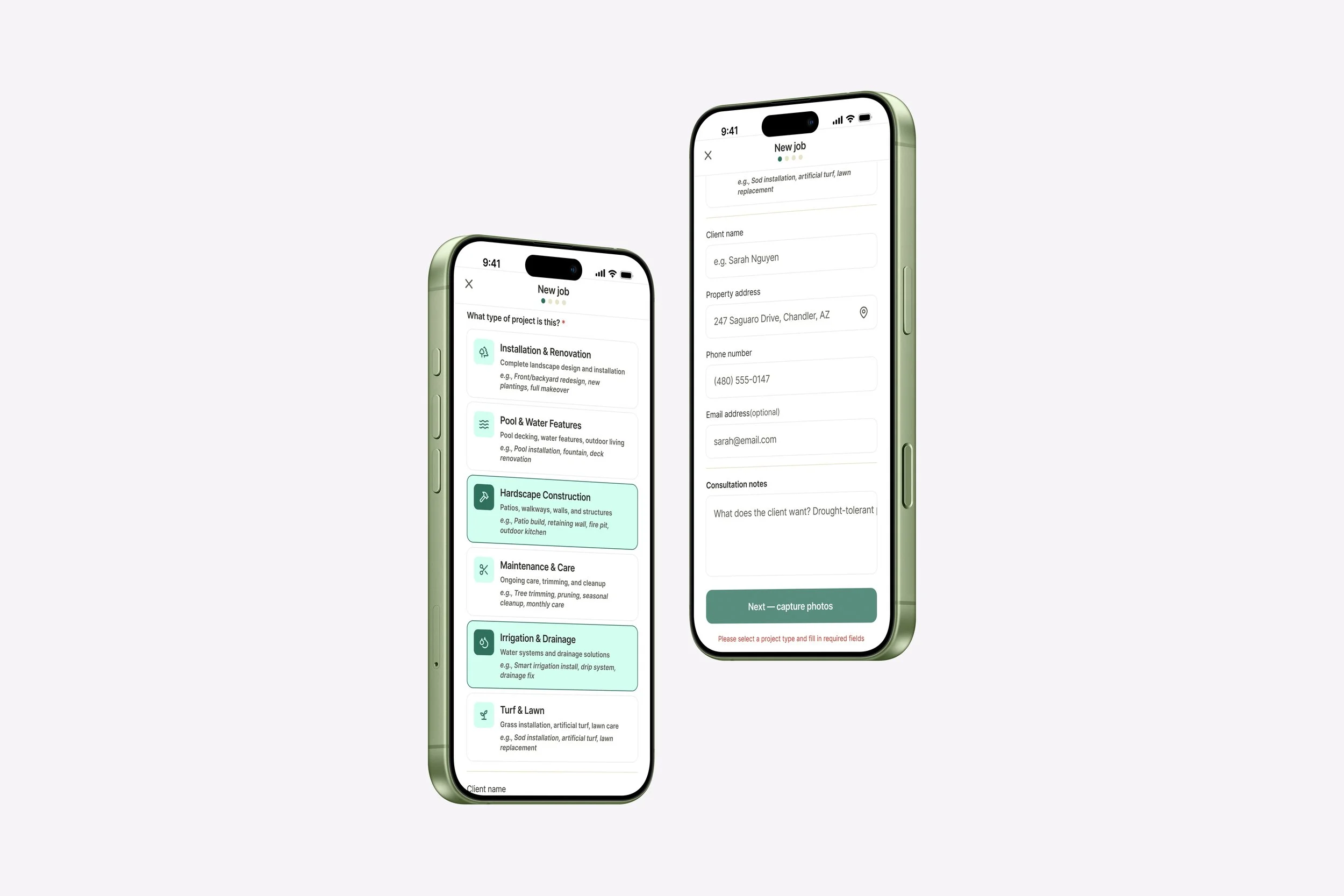
The “new job” flow asks questions about the type of project and client information along with consultation notes to help generate context-specific imagery within the AI-generated proposal.
We mapped a ten-task user flow that covered every decision point in that sequence, from photo capture through proposal delivery, and stress-tested it against landscapers’ real-world constraints. Every screen had to function in bright sunlight with one thumb. Every interaction had to communicate its purpose without a tutorial. Every transition had to feel like forward momentum, not process overhead.
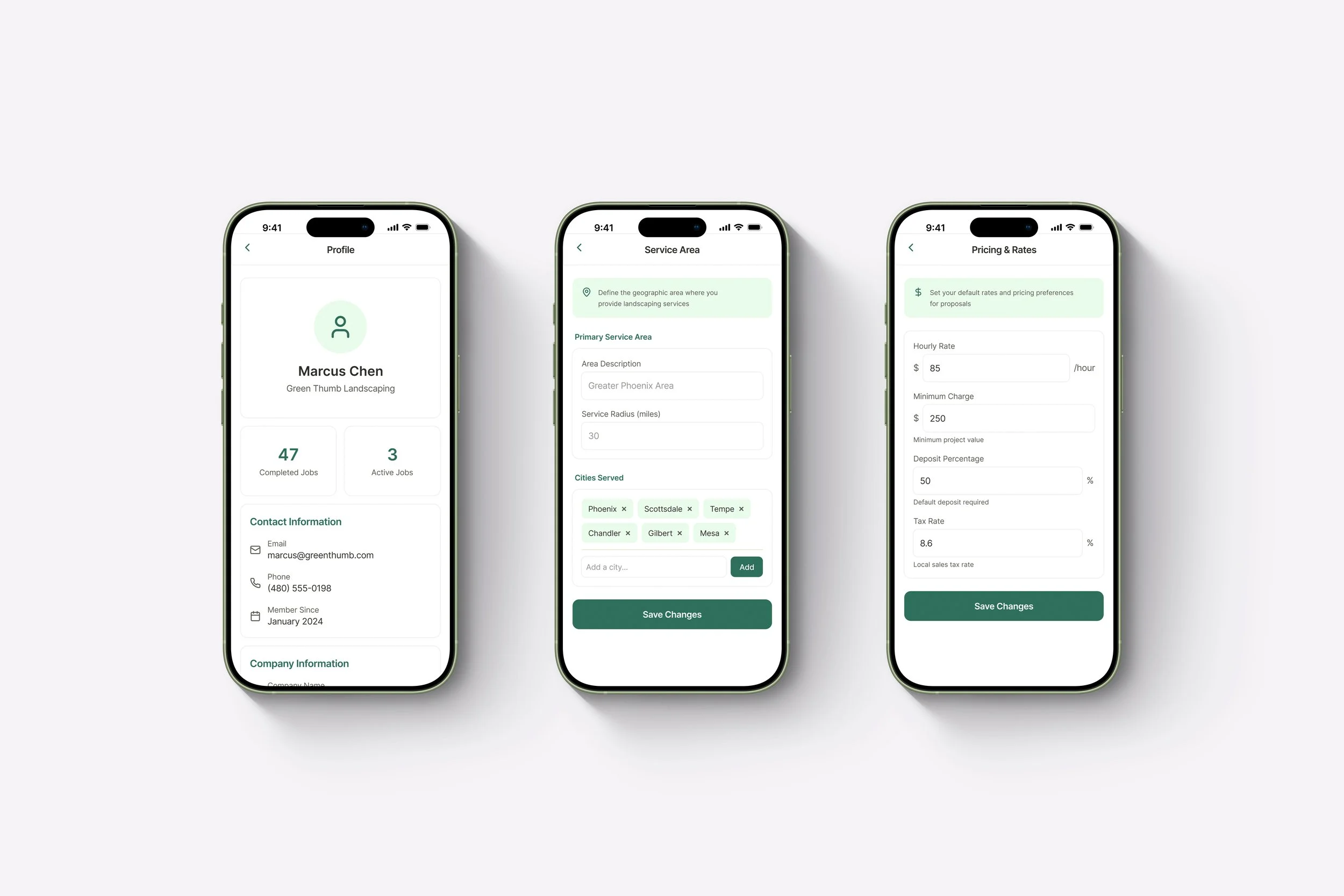
Client profiles within CurbReady are customizable, along with the landscaper’s service area, hourly rates, minimum charge, deposit requirements, and area tax rate.
Usability testing with five participants confirmed an 84% overall task success rate across the prototype, with six high-severity findings that shaped ten prioritized design recommendations. The most critical issues centered on navigation clarity in the proposal builder and feedback visibility during AI render generation. Those findings informed a revised prototype with documented specifications ready for developer handoff.
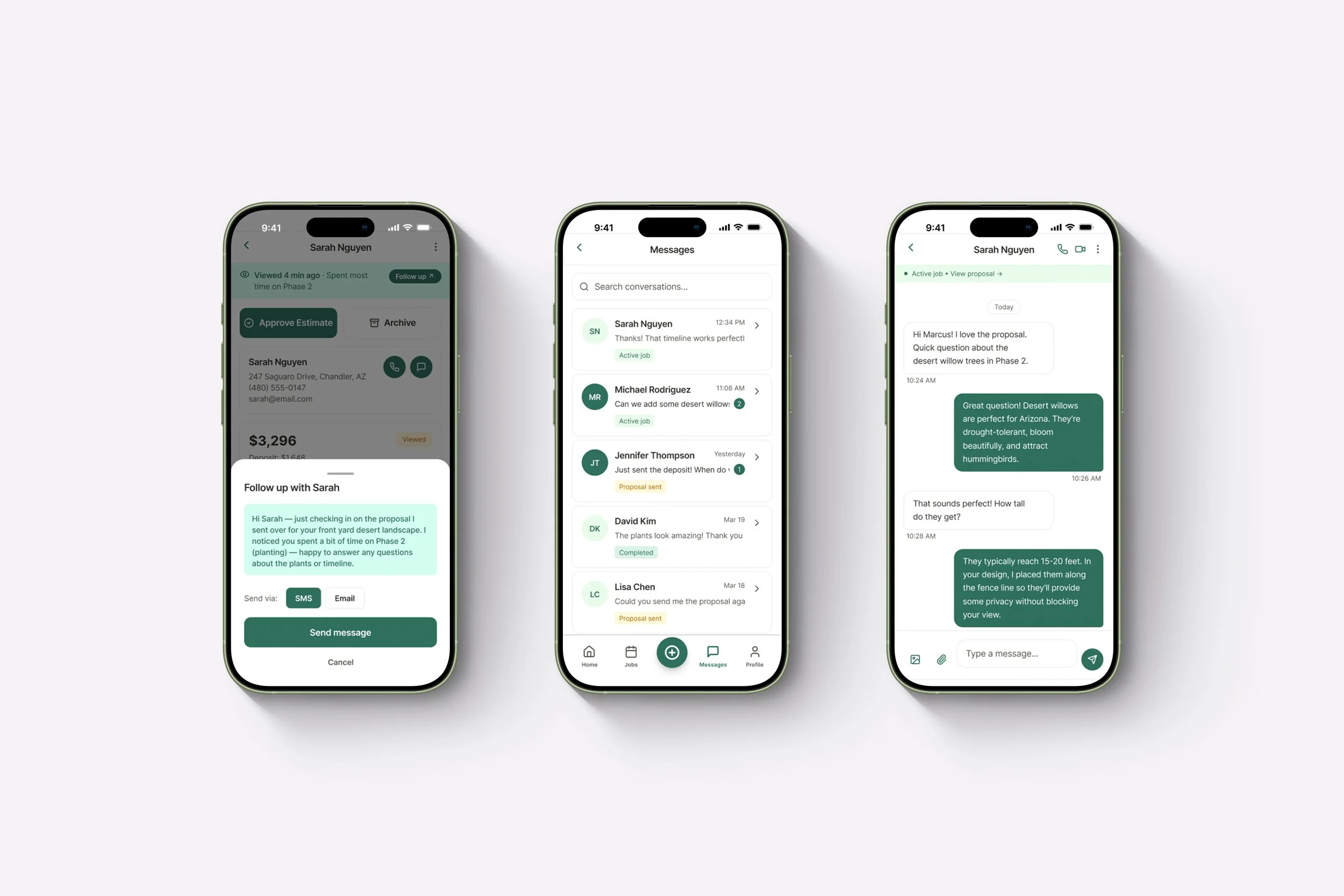
AI-generated in-app messaging allows the landscaper to communicate with the client directly from the app, while the client would receive messages as an SMS text message or an email, alleviating the need to respond quickly or after-hours when clients may be more available.
The Outcome
CurbReady.ai now has a research-validated design foundation, a tested Figma prototype, and a prioritized recommendation set that sequences critical-path fixes ahead of exploratory features. The work gives the development team a clear picture of where users succeed, where they struggle, and what to build first.
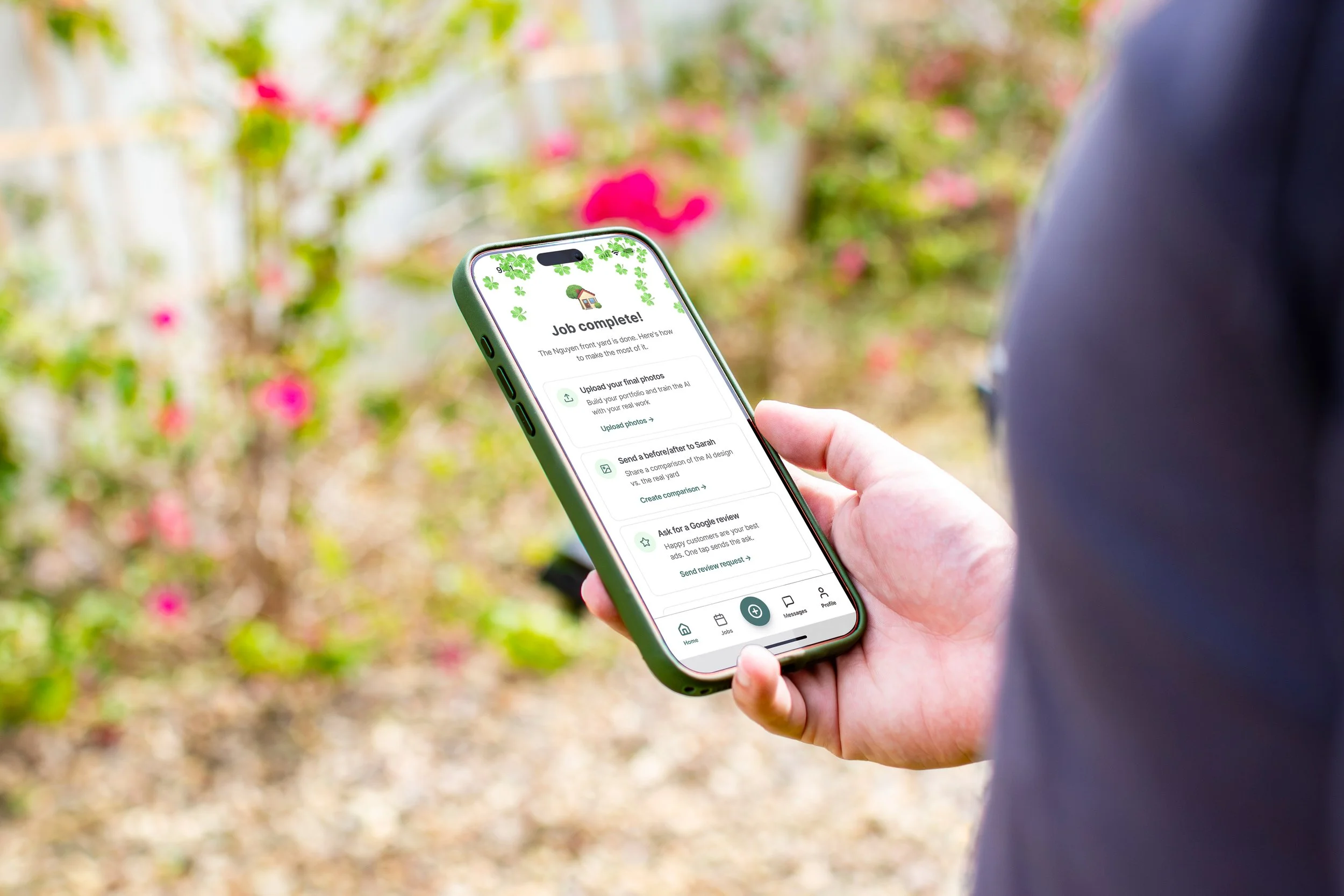
A seasonal animation introduces surprise and delight at high-effort areas of the project to maintain user satisfaction and excitement in using the product.
More importantly, it gives landscapers a proposal tool that respects how they actually work. Marcus does not need a dashboard. He needs something that helps him close the job he is standing in front of right now. CurbReady was designed for that moment, and the research proved it can deliver.
Collaborators
Cameron Jo’van — Client
Cameron Rennacker — Creative Strategist, Project Manager, Human Factors Engineer, UX/UI Designer, Photographer, Video Editor
Halle Wilden — UX Researcher, Writer, Human Factors Engineer
Atharva Pargaonkar — UX/UI Designer, Interaction Designer
Ruby Hassan — UX/UI Designer
Dr. Heather Lum — Faculty Expert