AgriDrone Multi-Role Agriculture UAV System
The Problem
American farmers manage an average of 466 acres (USDA, 2025). That's roughly 353 football fields of crops to monitor, livestock to track, and soil conditions to assess—often with nothing more than visual inspection, manual soil sampling, and headcounts done on foot or by truck. It's slow. It's expensive. And it misses problems until they're already costing money.
The drone market could provide an answer to this problem, but not in its current state. You can buy a thermal imaging drone for livestock monitoring. Or a spraying drone for precision agriculture. Or a mapping drone for field analysis. But most farmers can't justify three $15,000+ unitask systems.
Instead, what if one platform could adapt to all of these needs?
The answer became AgriDrone—a modular UAV system designed to function as a flying agricultural workstation. Instead of single-purpose hardware, we designed a flexible platform combining advanced imaging, smart sensors, and quick-swap payloads that could handle crops one day and livestock the next.
But flexibility creates complexity. And complexity is the enemy of usability, especially for operators working 12-hour shifts in the field. Our job was to design displays, controls, and workspaces that made this complexity manageable.
Three Core Capabilities
AgriDrone is built around three integrated systems that work together to give farmers real-time insights and operational flexibility.
The first is vision. We equipped the UAV with high-resolution cameras capable of generating real-time heat maps of fields, identifying nutrient deficiencies via color analysis, and monitoring livestock via automated counting. Thermal imaging highlights injured or isolated animals, while AI-based recognition systems provide early warnings about predator activity.
The second capability is sensors. Beyond imaging, onboard modules extend situational awareness in ways cameras alone can not achieve. Soil and nutrient sensors optimize spraying patterns in real time, reducing waste and improving crop yield. Air quality sensors monitor methane and ammonia levels in barns, catching ventilation problems before they harm livestock. Ground-penetrating radar detects underground water tables to support long-term land use planning. These sensors turn the drone into a flying diagnostic lab.
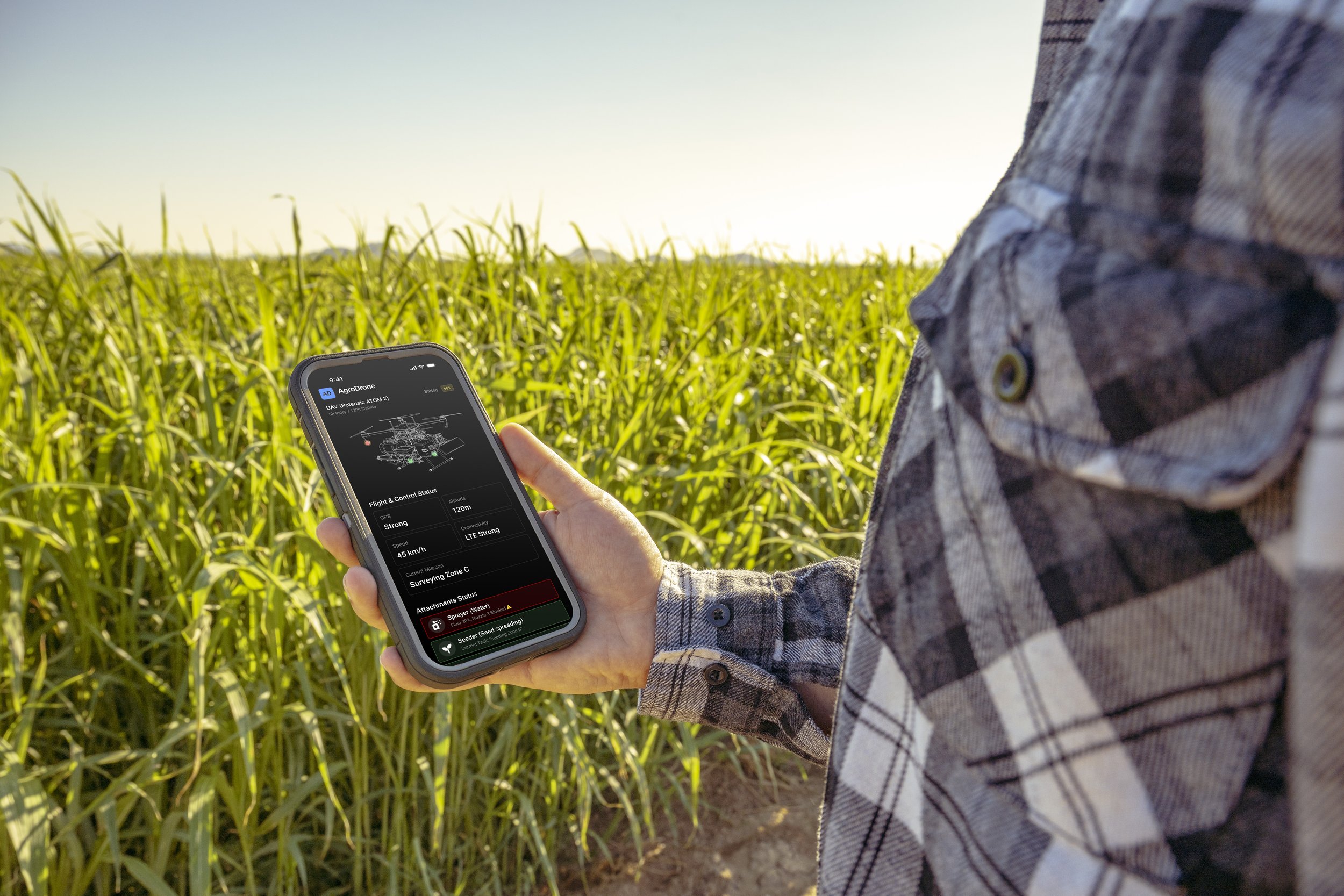
The third is modularity. A quick-swap payload system ensures the UAV can adapt to evolving needs. In one mission, it might spray fertilizers or pesticides with precision nozzles. In another, it might deliver tools to field workers or support a larger piece of farm equipment, such as a tractor or plow. This modular approach maximizes the UAV’s utility and reduces the need for multiple specialized drones. Farmers can now have a single platform that can grow with their operation.
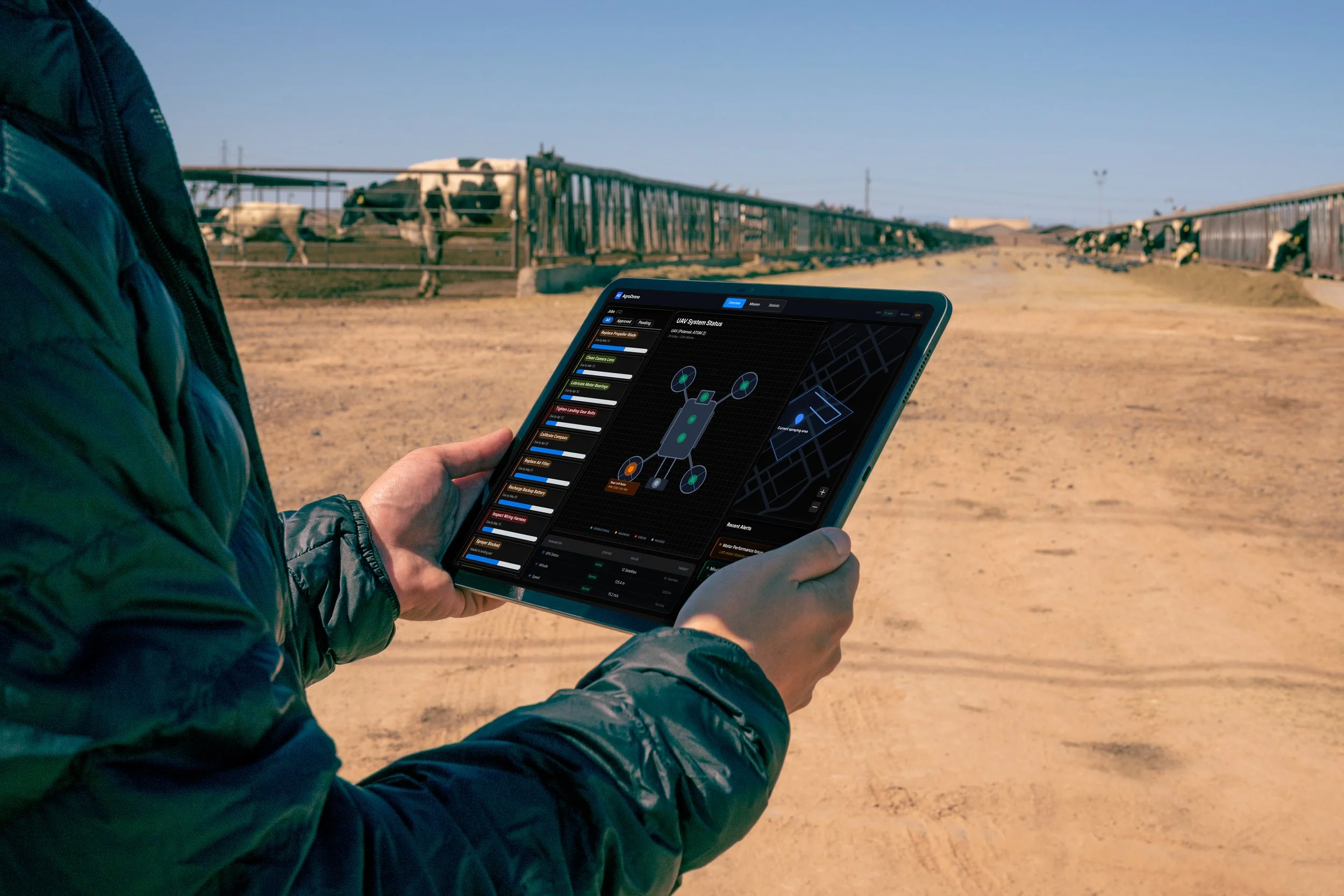
Together, these three capabilities—vision, sensors, and modularity—make AgriDrone adaptable, efficient, and ready to meet the long-term needs of modern agriculture.
Understanding the Operators
We designed AgriDrone for three operators working in tandem. These operators work in different contexts with different priorities, and that shaped the interface design.
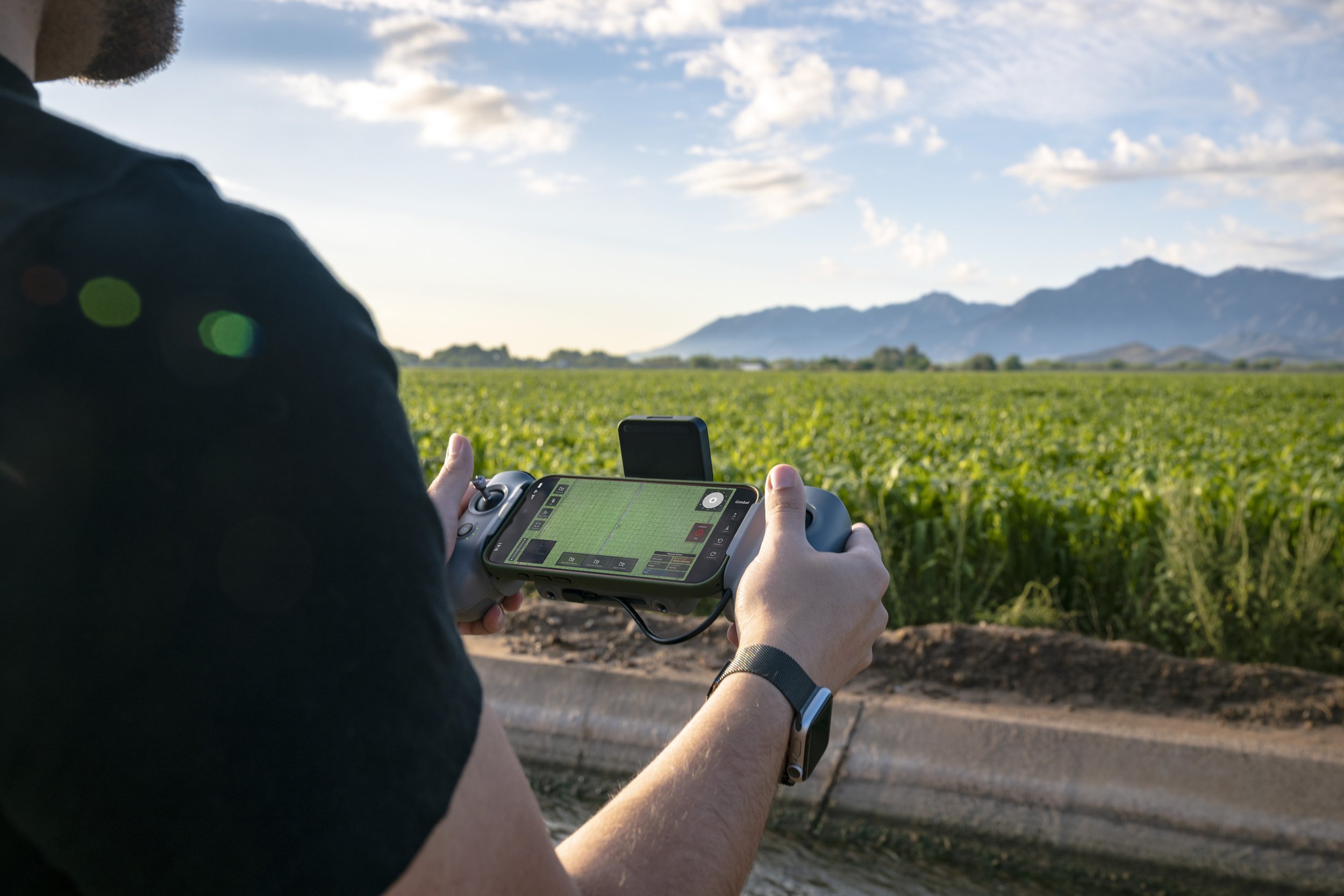
The pilot is the farmer. They are out in the field with a handheld controller, managing flight and vehicle control with altitude, heading, stabilization, and more. They need to keep their eyes on the actual environment around them while monitoring the screen, often in bright sunlight, while wearing gloves amid wind and dust. Their interface lives on a physical controller that needs to work like an extension of their hands.
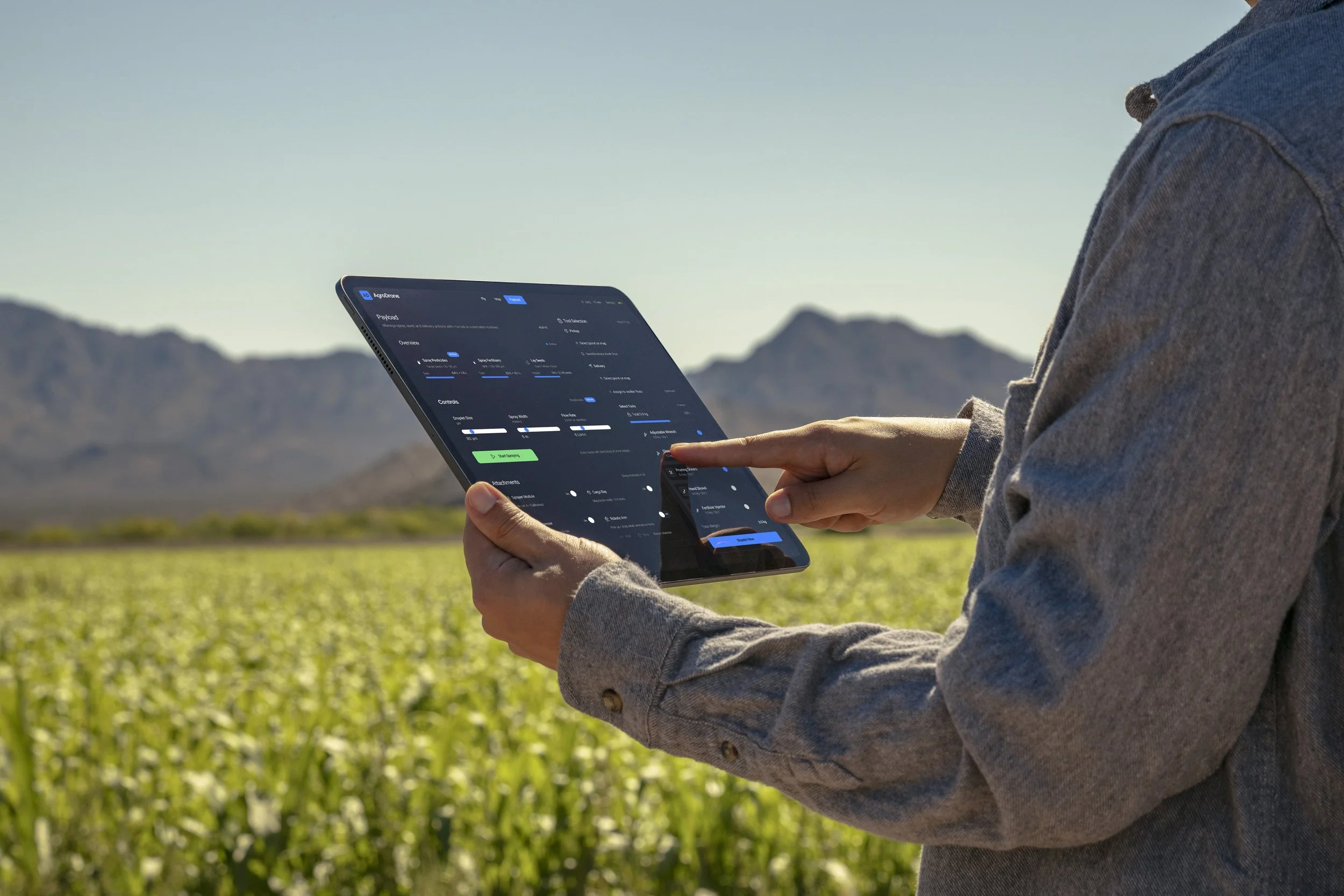
The technician handles maintenance and mechanical troubleshooting. They are the person who swaps modules, diagnoses sensor issues, adjusts spray parameters, and keeps the drone airworthy between missions. Their interface lives on a tablet they carry while working directly on the hardware. They need quick access to system diagnostics, module health, and the ability to coordinate with both the farmer and remote support without putting down their tools.
Remote support is the drone company employee who can monitor operations and step in when complex situations arise. They are desk-based and available on-call 24/7 from a multi-monitor setup. While they can fly the drone remotely, their primary job is to support the farmer when things get uncertain or technical. They are a safety net, with experts in seeing patterns across multiple flights and catching problems before they become emergencies.

These three users are a coordinated team with diverse expertise, environments, and information needs, meaning their interfaces need to work together. They need displays and controls that support shared awareness without creating information overload, and that keep them in sync without constant radio chatter, second-guessing, or overriding each other's actions.
The farmer needs to trust that the technician has properly configured the drone. The technician needs to know what the farmer is trying to accomplish so they can optimize settings. Remote support needs visibility into both perspectives to intervene effectively when called upon.
Collaborators
Adia Lee - Aviation Specialist, Researcher, Human Factors Engineer
Stephan Lee - UX/UI Designer
Yi-Hsuan (Michelle) Chen - UX/UI Designer
Subhiksha Shanmugam - UX/UI Designer
Cameron Rennacker - Creative Director, UX/UI Designer, Project Manager, Human Factors Engineer, Researcher, Photographer, Drone Pilot/Videographer
Dr. Jamie Gorman — Faculty Expert